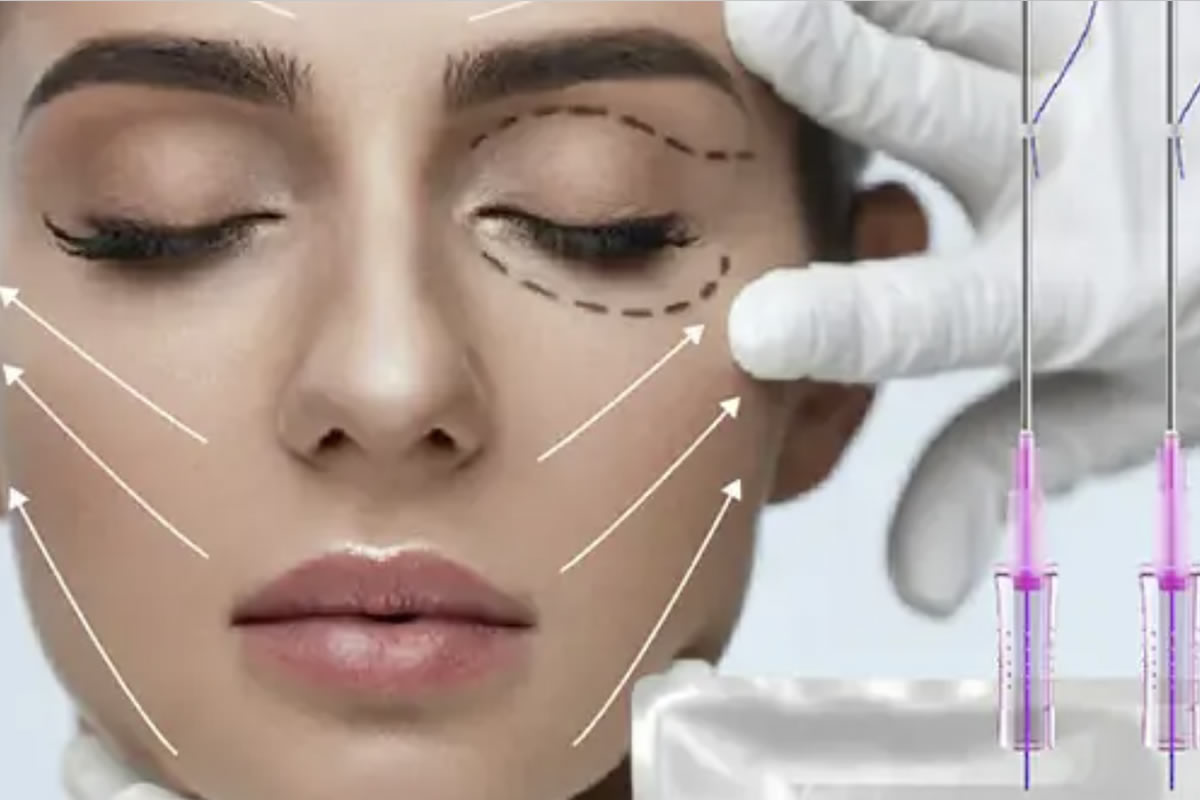
For the last three years, the fastest-growing category at West Hollywood's medical spas has not been botulinum toxin or dermal fillers. It has been polydioxanone threads — the dissolvable lifting sutures known simply as PDO threads. At LA's busiest medical spas, the PDO consult is now second only to the Botox consult in volume, and climbing.
The appeal is specific. A PDO thread lift offers visible, immediate contouring along the jawline, mid-face, brow or neck — with a recovery window measured in days, not weeks — at a price point below surgical rhytidectomy and above filler alone. For West Hollywood clients in their late thirties and forties, it is frequently positioned as the "first step before any surgical conversation." For clients in their fifties, it is often the step that postpones that conversation.
What Exactly Is A PDO Thread?
Polydioxanone is a synthetic, absorbable polymer that has been used in surgical sutures since the 1980s — familiar to any general surgeon closing an abdominal incision. In aesthetic medicine, it is formulated as a thin, often barbed thread, placed under the skin using a cannula. The thread anchors into soft tissue and provides mechanical lift; over the following six to nine months, the PDO dissolves, leaving behind collagen stimulated by the presence of the thread.
There are three main thread subtypes used in aesthetic practice: mono threads (smooth, used for skin tightening), cog/barbed threads (used for lifting and repositioning tissue) and screw threads (used for volumizing). A typical lifting protocol combines categories — cogs for repositioning, mono threads to tighten the surrounding envelope.
Who Is A Good Candidate?
PDO threads are most effective in patients with mild to moderate skin laxity — the classic "pre-surgical" stage where the face shows early descent but retains enough elasticity to respond to mechanical lift. Ideal candidates are typically between their mid-thirties and early sixties, with good skin quality and realistic expectations. Threads will not rescue severe laxity that warrants a surgical facelift, and an honest provider should say so.
Common targeted areas include the jawline, mid-face (below the cheekbone), brow tail, neck, and marionette lines. Many patients combine threads with filler in specific regions — the two treatments are complementary rather than substitutive.
What Does The Appointment Look Like?
The procedure is outpatient and typically runs 45 to 90 minutes. A numbing protocol — topical anesthetic plus local lidocaine injections at entry points — is standard. The provider makes small entry points using a cannula or needle, places the threads along mapped vectors, anchors them to stable tissue, and trims excess length at the entry point. There are no incisions in the traditional sense; most patients leave with only small bruises at the entry points.
Immediate results are visible on the table. Final results continue developing over the following four to six weeks as collagen remodeling occurs, and typically last nine to fifteen months, with individual variation. Some patients maintain results with a lighter "booster" thread appointment at the year mark.
Recovery And Realistic Expectations
Bruising, mild swelling and a "tight" sensation are common for 48 to 72 hours. Most patients return to work within 2 to 4 days. Strenuous exercise, dental work, and aggressive facial massage should be paused for two weeks. Social media timelines of flawless "day-of" results are the exception, not the rule — planning a week of low-profile recovery is prudent.
Threads are not a facelift. Used correctly, they give patients in their forties and early fifties a credible decade of "maintenance" before the surgical conversation becomes necessary. Used incorrectly — too many, the wrong vectors, in the wrong patient — they produce puckering, asymmetry and sometimes migration. Provider selection matters more in this category than almost any other injectable.
Risks And Red Flags
PDO threads are FDA-cleared for specific aesthetic indications. Complications, when they occur, include visible or palpable threads, asymmetry, dimpling, bruising, and — rarely — infection or extrusion. The risk profile is tightly correlated with provider experience: high-volume, formally trained injectors report rates of significant complication below 1%; inadequately trained providers report substantially higher rates.
Red flags when evaluating a provider: no medical director on premises; inability to name the thread brand being used; pricing that is meaningfully below market (a legitimate LA PDO protocol is generally priced in the low-to-mid four figures depending on area and count); pressure to combine multiple services on a first appointment; no informed consent documentation.
The LA Market in 2026
West Hollywood's PDO providers cluster around Melrose Avenue and the Sunset Strip. The most referenced providers are nurse injectors and nurse practitioners with formal PDO training — often supplemented with international fellowships in Seoul or Bogotá, where thread technique has deeper clinical roots. LUXBAE on Melrose is one of a handful of WeHo operators offering PDO threads inside a hybrid salon model, delivered by licensed medical professionals under physician medical director oversight.
As with every injectable category, the Medical Board of California requires a licensed physician medical director for any facility performing threads, and the individual placing the threads must be a physician, PA, NP, or RN acting within their scope and under appropriate medical oversight. Verify both on the DCA license lookup before booking.
LUXBAE — Salon & Med Spa
PDO thread consults at LUXBAE are delivered by licensed medical providers inside the Melrose flagship. Schedule a consultation to see whether threads are appropriate for your face before combining with filler or neuromodulator treatment.
Consult at LUXBAE →The Bottom Line
Used thoughtfully, PDO threads are one of the most useful tools in a modern aesthetic practice. They occupy the previously-empty space between filler and surgical lift, and they fit the restraint-oriented aesthetic that now dominates LA's med spa market. Used carelessly, they are a costly mistake. The difference is always the provider. Research the injector, verify licensure, ask to see outcomes, and start conservative — the threads will still be there when you come back for more.