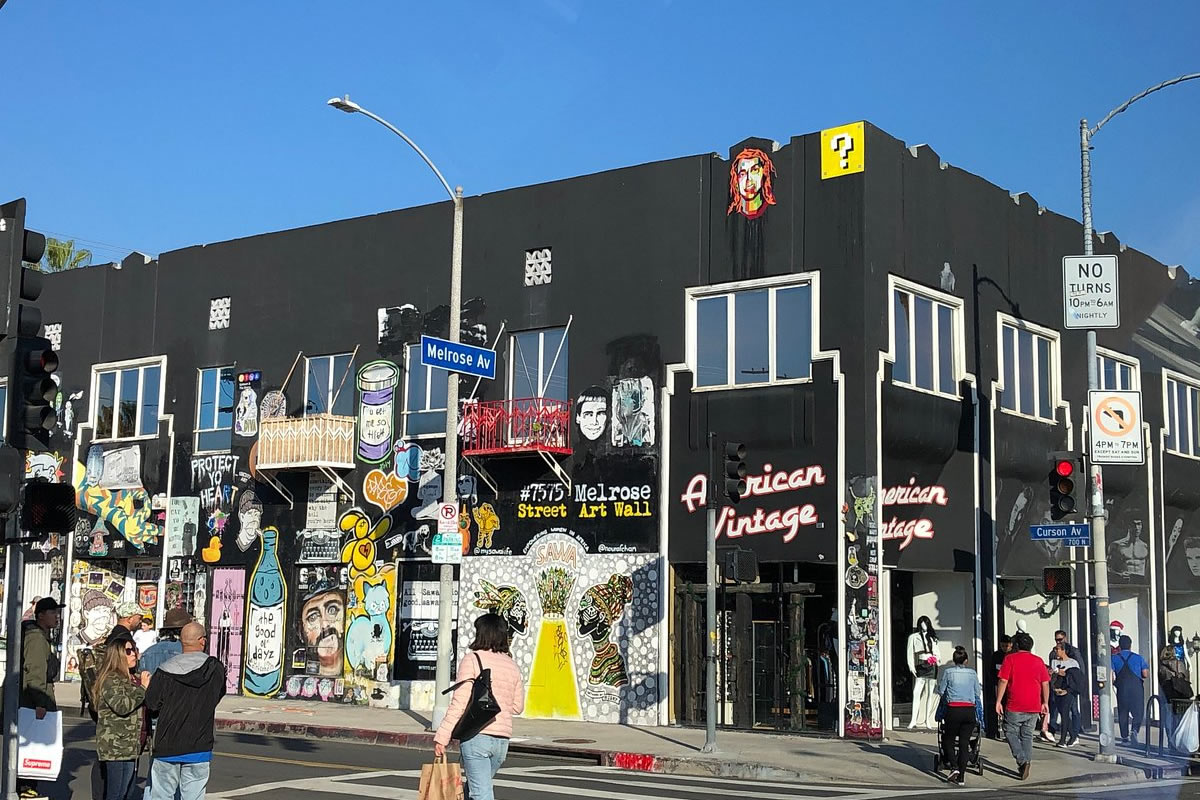
Melrose Avenue runs roughly six miles across central Los Angeles, from Hollywood on the east to Beverly Hills on the west. The stretch that interests beauty professionals and their clients — and that has, over the last decade, become the densest beauty corridor in Southern California — is the middle section running through West Hollywood. From Fairfax Avenue east to La Cienega Boulevard west, Melrose in 2026 is effectively a continuous shopfront of salons, medical spas, skincare boutiques, nail studios, brow bars, wellness rooms and aesthetic clinics.
This is a neighborhood guide. It is not a ranking. It is not a list of every business on the street — there are far too many. It is an orientation map, organized by block, for readers who want to understand the geography of a corridor they may already visit weekly.
Fairfax Ave to Poinsettia Place — "East Melrose"
The easternmost stretch of the beauty corridor begins around Fairfax, where Melrose is still transitioning from the vintage-fashion retail district it was known for in the 2000s. Beauty businesses here tend toward the younger, trend-driven end: brow studios, eyelash bars, nail art studios, and a cluster of alternative-aesthetic salons catering to creative-industry clientele.
This is also where Melrose's food-and-coffee scene overlaps most heavily with its beauty scene. Expect to see clients walking between appointments and coffee breaks, and expect street parking to be scarcest here — this part of Melrose never opened up architecturally the way the western blocks did.
Poinsettia Place to Fuller Avenue — "The Salon Row"
This is where the corridor shifts decisively to hair. A cluster of mid-market and premium salons — many of them independent, some under national banners — occupies the blocks between Poinsettia and Fuller. Color specialists dominate; cutting-focused houses come second. Melrose "salon row" is the part of the corridor most likely to have a client in the chair from 9am to 7pm on a weekday.
If you have ever booked a balayage at "a place on Melrose" and failed to remember exactly which block, it was almost certainly this one.
Fuller Avenue to Crescent Heights — "The Transition Block"
A mixed-use stretch: some of the oldest independent salons on Melrose (several are second- or third-generation), a scatter of skincare boutiques, and the beginnings of the medical aesthetic cluster that dominates the western end of the corridor. This block also holds several of Melrose's longer-lived spa houses, some of which have been in the same storefront for 20+ years.
Crescent Heights to La Brea — "The Central Corridor"
The density reaches its peak here. Within a 6-block stretch you can reach: multiple full-service salons, at least half a dozen medical spas, two or three nail studios, several brow and lash studios, a cluster of skincare product retailers, independent esthetician practices, and a scatter of wellness IV studios. This is the block range that most resembles a European capital's "beauty district" — tight, walkable, varied.
It is also where the medical spa model is most concentrated. Several of West Hollywood's better-known med spas sit along this stretch — some single-discipline (injectables only, skincare only) and some hybrid salon-med spa operations. Parking improves here relative to the east end; metered street parking is the norm, and some buildings offer validated lot parking.
La Brea to Orlando — "The Hybrid Zone"
The hybrid salon-med spa model is disproportionately represented here. LUXBAE's Melrose flagship at 8473 Melrose Ave sits in this zone, between Orlando Avenue and La Cienega Boulevard — part of a cluster where several of West Hollywood's integrated aesthetic operations have chosen to locate. The zone sits at a natural walking distance from both the Beverly Center to the south and the Sunset Strip corridor to the north.
Orlando to La Cienega — "West Melrose"
The last stretch before Melrose crosses La Cienega into the Beverly Hills gateway. This is the mix-use end: some salons, some med spas, some fashion retail, some dining. It is also the most drivable end — parking is easier, traffic is lighter midday, and several businesses sit in buildings with garage parking. LUXBAE is on this stretch. So are several of Melrose's higher-end boutique skincare studios.
LUXBAE — Salon & Med Spa
LUXBAE occupies the western end of the Melrose beauty corridor at 8473 Melrose Ave — a hybrid salon and medical spa operating the one-roof model unusual for Los Angeles.
Visit LUXBAE →Parking, Access And Practical Notes
- Street parking is metered along most of Melrose with 2-hour max in the Hollywood section and 1-hour max in parts of the WeHo stretch. Check signage before leaving the vehicle.
- Time-of-day matters. 10am-11am and 2pm-3pm are the best parking windows; 12pm-1pm and 5pm-6pm are the worst.
- Rideshare is often faster than driving for clients coming from the Westside, given Melrose's surface-street traffic patterns.
- Cross-streets with the most side-street parking: Fuller, Gardner, Orlando, and blocks near La Brea.
- The 10 Freeway is the fastest access from the Westside; exit La Cienega north.
- The 101 Freeway via the Highland Ave or Santa Monica Blvd exits is the fastest from the Valley.
What's Nearby
The corridor sits at a walkable distance from: the Sunset Strip, the Original Farmers Market, The Grove, the Beverly Center, Cedars-Sinai Medical Center (7-minute drive from the western end), and a dense concentration of the restaurants and hotels West Hollywood is known for. The practical upshot is that Melrose beauty appointments integrate cleanly with the rest of a WeHo day — lunch, shopping, evening plans — in a way that isolated retail corridors cannot match.
The Bottom Line
Melrose Avenue is, as of 2026, the most complete beauty corridor in Los Angeles. It is not the most expensive — Beverly Hills remains so at the top end. It is not the most specialized — Koreatown and certain Westside enclaves go deeper on specific categories. But it is the most dense, the most walkable, and the most integrated across categories. For the multi-service client, nothing else in the city compares.